Search results for: 'acid'
-
MTHFR Test- DNA mutation Analysis of Methylenetetrahydrofolate Reductase$800
Learn MoreQuest Diagnostics test code 17911 is for a DNA mutation analysis of Methylenetetrahydrofolate Reductase (MTHFR). The test determines if a patient has one, two, or no copies of either of the two mutations in the MTHFR gene, C677T and A1298C.
Changes in the methylenetetrahydrofolate reductase gene can lead to certain health conditions. One of them is hyperhomocysteinemia (high blood levels of homocysteine), which is a risk factor for cerebrovascular disease, cerebral vein thrombosis, coronary artery disease, myocardial infarction, and venous thrombosis. At least 40 mutations in the MTHFR gene have been identified in people with homocystinuria, a disorder in which the body is unable to process certain amino acids properly.
-
Lipid (Cholesterol) Panel (LDL, HDL, Triglycerides)$16
Learn MoreLipid Panel: Evaluates the risk for developing atherosclerosis (arterial plaque) and coronary heart disease. This test includes: Total Cholesterol, Triglycerides ,HDL Cholesterol, LDL Cholesterol, Total Cholesterol/HDL Ratio. FASTING REQUIRED.
-
Cardio IQ Advanced Lipid Panel$192
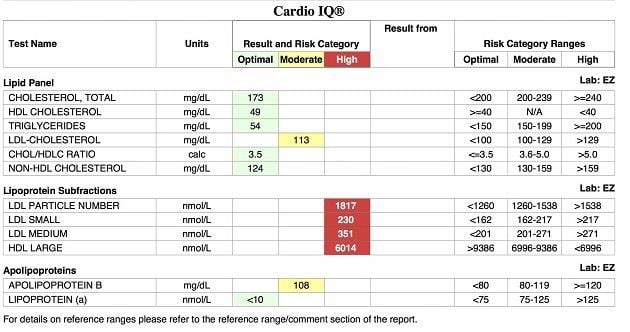
Learn MoreThe Cardio IQ® Report provides an in-depth assessment of cardiovascular risks to help physicians recommend the ideal individualized treatment option for patient to minimize cardiovascular disease.
The report is simple, yet comprehensive. It is color-coded to display progressive risk values versus goal using “optimal,” “moderate,” and “high-risk” categories and grouped by functional categories.
Cardio IQ Advanced Lipid Panel The Cardio IQ Advanced Lipid Panel includes:Total Cholesterol, Triglycerides, HDL, LDL and Cholesterol/HDL ratio, LDL Particle Number, LDL Peak Size, LDL Pattern, HDL Large, LDL Small, LDL Medium, Apolipoprotein B, Lipoprotein (a). Fasting is not required prior to collection of a lipid panel. Results for this test take 2 weeks to receive.
-
Homocysteine$41
Learn MoreElevated levels of homocysteine in the blood, known as hyperhomocysteinemia, have been linked to an increased risk of cardiovascular disease, including heart attack and stroke. High homocysteine levels may also be associated with an increased risk of certain other health conditions, such as osteoporosis and pregnancy complications.
-
C-Reactive Protein- High Sensitivity hs-CRP$43
Learn MoreThis high sensitivity CRP test is used along other blood markers to assess a patient's potential risk for cardiovascular disease. To illustrate the difference between CRP and hs-CRP, traditional testing measures CRP (quantitative) within the range of 10 to 1,000 mg/L, whereas hs-CRP values range from 0.5 to 10 mg/L. In simpler terms, hs-CRP measures trace amounts of CRP in the blood. Hs-CRP is the analyte of choice for cardiovascular risk assessment